
Pull up the closest palm tree and settle in to learn our individual “Desert Island” picks for horror books.
Episode 231 – Desert Island Picks: Horror Books
://traffic.libsyn.com/secure/podcastmacabre/PM_Episode_231_Final.mp3

"Keep repeating: It's only a podcast. It's only a podcast. It's only a podcast . . . "
Pull up the closest palm tree and settle in to learn our individual “Desert Island” picks for horror books.
Episode 231 – Desert Island Picks: Horror Books
://traffic.libsyn.com/secure/podcastmacabre/PM_Episode_231_Final.mp3
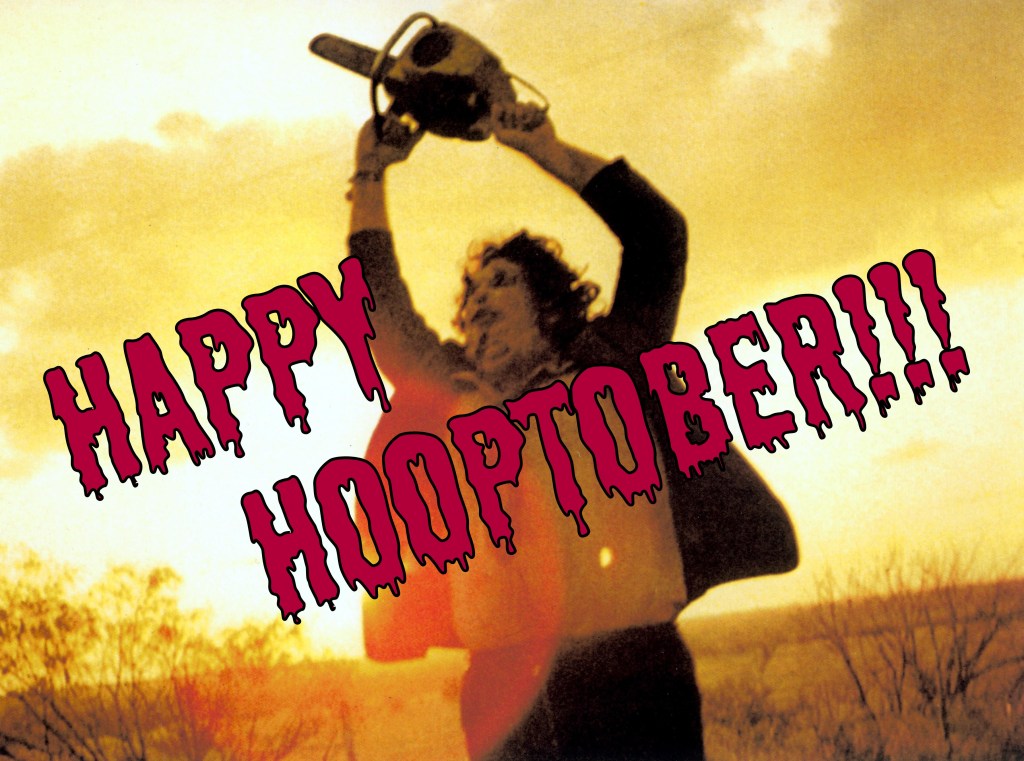
We’re making our lists and checking them a dozen times as HoopTober 7.0 is upon us on Letterboxd. And who better to have on to talk about it than the mad genius behind it, Cinemonster! Please enjoy this fun as hell interview and maybe join the challenge yourself. (Check all the links in the show notes, too!)
Episode 230 – Happy HoopTober! (with special guest Cinemonster!) https://traffic.libsyn.com/secure/podcastmacabre/PM_Episode_230_Final.mp3
Cinemonster’s HoopTober Se7en Challenge List: https://letterboxd.com/cinemonster/list/hooptober-se7en-we-have-such-masked-socially/
Jenny’s HoopTober List: https://letterboxd.com/tattooedjenny/list/hooptober-70/
Joe’s HoopTober List: https://letterboxd.com/gotmewrong/list/hooptober-70-2020/
Chris’s HoopTober List: https://letterboxd.com/duckman/list/hooptober-se7en-whats-in-the-letterboxd/
Jon Ursenbach’s Charity Drive HoopTober List: https://letterboxd.com/erunion/list/hooptober-7/
ruinmysleep’s 499 Nights of Female-Fronted Frights: https://letterboxd.com/ruinmysleep/list/365-nights-of-female-fronted-frights/
Letterboxd’s 250 Top Horror Films: https://letterboxd.com/darrencb/list/letterboxds-top-250-horror-films/

We wrap up this year’s Summer Of Stephen with a visit to Castle Rock, Maine, via NEEDFUL THINGS. Caveat Auditor, Fright Fans!
By Joe Meyers
I like to think most people my age discovered Sasquatches the same way I did, the Bigfoot episode of IN SEARCH OF… that originally aired on April 28, 1977. As I would have only been two years old at the time, it was surely a rerun sometime during the show’s initial six year run that I caught. Young me was glued to the television screen from the moment Leonard Nimoy began speaking and the synth theme music played. Just the still photo from the Patterson-Gimlin film alone turned me into THE X-FILES’ Fox Mulder, I *WANTED* to believe. So, when I found out Max Brooks, author of the amazing Zombie epic WORLD WAR Z, was releasing a book about Bigfoot it was immediately added to my summer read list.
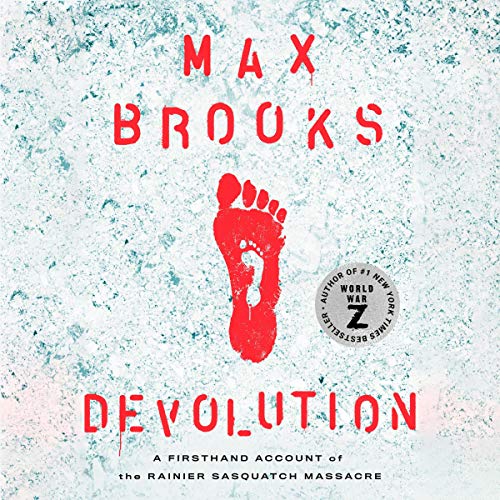
DEVOLUTION is about a reporter trying to piece together what happened to the people living in a secluded, high-end, eco-friendly community of Greenloop about a year after a volcanic eruption of Mount Rainier. The story unfolds via journal entries kept by Kate Holland, a Greenloop resident who is still missing at the time of the investigation, interviews with experts on zoology, and a Forest Service officer. What begins as a tale of people trying to live in harmony with Mother Nature turns into a nightmare when the residents discover they aren’t the only living things in the area searching for food and survival.
After the eruption of Mount Rainier, Greenloop is cut off from the outside world. The one access road to the community is impassable and the drone deliveries from Seattle they relied upon for food, supplies, and other goods were no longer possible. As the group tries to decide the best course forward, do they wait to be saved or venture out to find help?, it becomes clear the wildlife, spoiler…it’s TOTALLY Sasquatches!!!!, has taken an interest in them.
While I appreciate the amount of research that must have gone into this novel, I will say the first half of it was a struggle at times. None of the characters were really grabbing my interest at first, and it all felt more like set up than world and/or tension building. Thankfully that all changed around page 130. Once we get the first clear Sasquatch interaction with the community the book had me locked in tight. The final half of DEVOLUTION s the pure definition of “page turner.“
Even with my feelings on the beginning, the sheer quality of the last half of the book has firmly planted this on my “I recommend” list. Especially if you’re a fan of Max’s and/or a fan of Bigfoot. While I read the book, I have to say the audiobook cast looks like it’s more than worth a listen. The cast includes Max Brooks himself, Judy Greer, Jeff Daniels, Nathan Fillion, Mira Furlan, Kimberly Guerrero, Kate Mulgrew, Kai Ryssdal, and the always incredible Steven Weber.
Legendary Entertainment optioned the book for an film just prior to the novel’s release by DelRay on 6/16/20. I’m looking forward to who they tap to write the script, and seeing how they translate the DEVOLUTION’s journal entry sections to on screen action. Fingers crossed it’s not a “film adaption in title only” situation, because certain events in the finale were edge of your seat intense. Plus, like with my beloved Werewolves, we don’t get nearly enough good Sasquatch horror movies and I believe a more faithful adaption of this source material could be one of the good ones.

Join us this week for a discussion of SINISTER (2012) and SINISTER 2 (2015), a deep dive into the news, and a roundtable sharing of what we’ve been watching the last couple weeks.
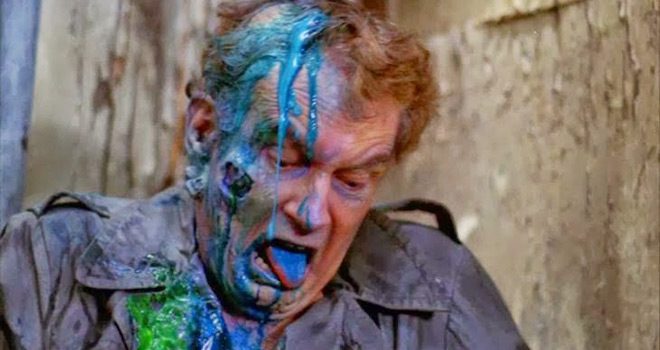
Get ready to get gooey as we dive deep into the melting mayhem of THE STUFF (1985) and STREET TRASH (1987) in this edition of Drive-In Double Feature.
Episode 227 – Drive-In Double Feature: THE STUFF (1985) and STREET TRASH (1987)
By Joe Meyers
“Just sit right back and you’ll hear a tale, a tale of a mushroom trip…”

A little over a year ago I was at a get-together with my girlfriend’s family, and found myself in a conversation with a lovely, horror loving couple, Ed and Toni. At some point Ed asked me if I’d ever seen ATTACK OF THE MUSHROOM PEOPLE, and went on to say it was basically the horror version (possibly part inspiration?) of GILLIAN’S ISLAND. To say I was immediately curious about the film would be an understatement. I loved GILLIAN’S ISLAND as a kid, and I would often come up with horror scenarios for the characters after watching episodes.
It took me some time after my chat with Ed and Toni before seeing MANTANGO (aka ATTACK OF THE MUSHROOM PEOPLE), but it was worth the wait. This 1963 film was written by Takeshi Kimura, directed by the legendary Ishirō Honda, and was loosely based on William H. Hodgson’s short story, “The Voice in the Night.” Starring Akira Kubo, Kumi Mizuno, Kenji Sahara, Hiroshi Tachikawa, and Yoshio Tsuchiy the movie really is about a trip on a yacht that wrecks off the shore of a seemingly deserted island…and yes, the characters feature a skipper, his mate, a professor, a wealthy man, and a celebrity among others.

As the group makes their way across the island they discover vast growths of strange mushrooms, and eventually come across a shipwreck on the shore. Exploring this ship they find evidence that whoever had been onboard was likely conducting nuclear experiments, possibly the cause of the mutated mushrooms. The longer they’re on the island to more certain individuals begin to unravel. At first they all agree to not eat the mushrooms, but as food is in sort supply some fail to keep that promise. The result is distrust between the members of the group and, once the mushrooms begin to alter the mind and body, upgrades to terror and paranoia. Honda always said the film was about drug addiction, and how people can loose themselves in their addiction. That social commentary does come across in the script, however, the DOCTOR WHO-like make up effects for the Mushroom People has this film far more memorable as a 1960’s slow burn, monster movie to me.
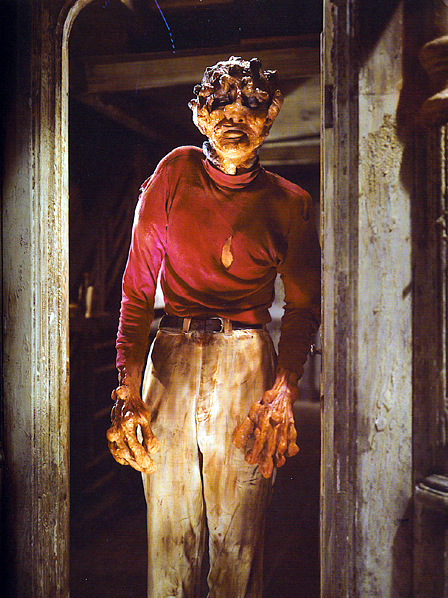
I enjoyed the movie, but I’d actually love to see an update of this plot idea. While MANTANGO is beyond tame by today’s standards, I think a reimagining/remake could really ratchet up the body horror. Using modern practical and visual effects, as the mutated ‘shrooms take over from the inside out, it could be as dramatic a difference as John Carpenter’s THE THING was from THE THING FROM ANOTHER WORLD. If you’d like to take the (longer than three hour) tour with these castaways over a 90 minute runtime as well, you can currently find the film listed as ATTACK OF THE MUSHROOM PEOPLE on Amazon Prime.
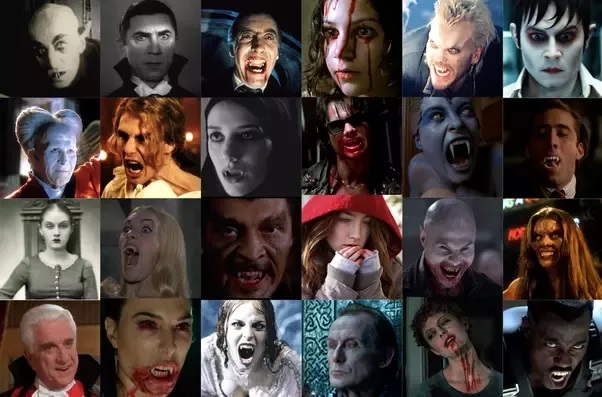
Being stranded doesn’t have to suck! Especially if you get to have you five favorite vampire flicks with you. Join us for another round of “Desert Island Picks” and see what each of us sunk our teeth into.

Flame on, Fright Fans! We are discussing Stephen King’s FIRESTARTER and the film adaptation in this edition of Summer of Stephen.

It’s Chris’s pick for this round of Drive-In Double Feature, and this pairing of titles ended up as a greater match than intended! Join us for a discussion and review of SISTERS (1972) and A TALE OF TWO SISTERS (2003).
Episode 224 – Drive-In Double Feature: SISTERS (1972) and A TALE OF TWO SISTERS (2003)
![DEVOLUTION: A FIRSTHAND ACCOUNT OF THE RAINIER SASQUATCH MASSACRE [Book Review]](https://podcastmacabre.com/wp-content/uploads/2020/08/cd80ccb6-2fbb-42a9-b129-33b0c0101095.jpeg?w=700)

 The Podcast Macabre